Milne Ice Shelf
Deception PointThe Milne Ice Shelf is a vast Arctic formation whose exceptional remoteness and depth of ice make it both a plausible archive of ancient events and a dangerous place to investigate them. In the story, it is the site of a discovery announced as evidence of extraterrestrial life, but also the setting where the discovery’s human and political costs become impossible to conceal. The shelf’s ice preserves the object at the center of the announcement; its exposed surface, surrounding sea, and isolation turn the same investigation into a struggle for survival.
Location and Physical Setting
The Milne Ice Shelf lies on the northern coast of Ellesmere Island, above the Eighty-second Parallel in the high Arctic. It is described as the largest solid ice floe in the Northern Hemisphere, four miles wide and more than three hundred feet thick. Those measurements establish a setting in which the surface is not merely a frozen landscape: it covers a deep, difficult-to-reach interior, while its remote position leaves a small expedition far from ordinary help.
NASA’s temporary installation on the shelf includes a habisphere and equipment operated in severe conditions. Rachel Sexton arrives in an ice tractor, climbing into its Plexiglas enclosure as the aircraft carrying her departs from the runway. She has a parka and gloves waiting on her seat, and heat coming from the tractor’s vents. Her host explains that only scientific personnel and immediate NASA support-team members are allowed on-site. The departure and restricted access make the expedition’s controlled, isolated character clear from her first moments there.
The habisphere itself is approached through a maze of translucent corridors. Lawrence Ekstrom leads Rachel through this structure, whose opaque plastic sheets are hung across taut wires; its floor is the ice itself, covered with rubber strips for traction. Armed NASA workers stand guard along the route. The temporary architecture does not separate the installation from the shelf so much as organize passage through it: ice remains the literal ground beneath an environment built for a restricted scientific operation.
The Buried Anomaly and Meteorite Discovery
The shelf becomes central to the investigation when PODS, NASA’s Polar Orbiting Density Scanner, detects an unexpected density anomaly. The satellite uses spectral-band technology to produce composite density scans of large areas and identify features such as slush, internal melting, or fissures. Two weeks before Rachel’s arrival, it detects something unlike the expected ice anomalies: an amorphous object about ten feet across, buried two hundred feet below the surface and harder than the surrounding ice.
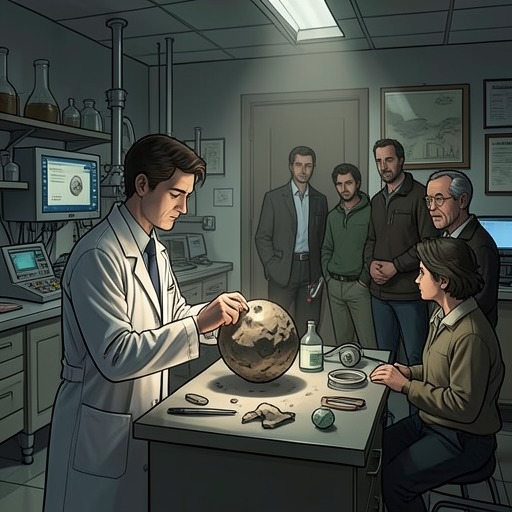
The density reading first points to an unusual rock rather than identifying its origin. The object is substantially denser than any rock known from Ellesmere Island or the surrounding four-hundred-mile radius. Ekstrom tells Rachel that it weighs more than eight tons and has been embedded beneath two hundred feet of solid ice for more than three hundred years. The location and depth make the discovery seem both ancient and secure, while the stone’s composition supplies the first reason to suspect that it did not originate nearby. Ekstrom identifies it as a meteorite.
The shelf’s ice thus functions as a natural enclosure around the object and as part of the evidence used to date its presence. The scientific claim depends on interpreting what PODS sees through layers of ice: a density contrast becomes a rock, and the rock becomes a meteorite whose apparent history supports a far-reaching claim. Rachel’s questions about how the stone arrived there register the gap between the satellite’s measurement and the larger conclusion drawn from it.
Investigation, Announcement, and Doubt
The discovery is prepared for public presentation as a major NASA announcement. In Washington, Zach Herney describes PODS’s detection of a large, high-density rock buried two hundred feet beneath the Milne Ice Shelf on Ellesmere Island. His account begins with the satellite’s observation and NASA’s response, giving the remote site a prominent place in a national political event. The scientific interpretation made at the shelf is therefore carried far beyond it, into a public argument over NASA and its credibility.
The ice shelf’s conditions also limit how readily the people closest to the discovery can correct that public account. After the attack, Rachel, Michael Tolland, and Corky Marlinson are stranded on floating ice, with the shelf visible in the distance. Rachel believes that the approaching announcement will rely on a documentary endorsed by four civilian scientists, all now dead. She suspects Ekstrom, who sent the investigators onto the ice and, in her view, had the most to gain, but she does not yet know the full truth. The contrast between the controlled claims made about the buried object and the uncertainty among its surviving investigators makes the shelf a site of contested knowledge as well as scientific work.
Attack and Survival on the Ice
The investigation’s physical setting becomes a danger in its own right when Rachel, Tolland, and Corky are left on a broad sheet of ice after an attack. Tolland understands that the ocean can take people quickly and without regard; the Milne Ice Shelf recedes as a distant outline. He knows that the powerful Arctic current from the Elizabethan Islands loops around the polar ice cap and will eventually skirt northern Russia, but that journey would take months and offers no practical rescue.
Their survival depends in part on the Mark IX suits. The suits have kept them dry, a crucial protection in the cold, and their thermal gel both cushions the fall and helps retain body heat. Tolland estimates that they may have thirty to forty-five minutes. Rachel, meanwhile, sees that Corky is moving but in pain and that Tolland is looking at her with regret. She suspects that the attack was meant to kill them and that Ekstrom may be responsible, while also considering whether Herney knew anything; she concludes that the President has likely been deceived. The shelf’s isolation turns those suspicions into an immediate practical crisis: there is little time to establish the truth or stop the announcement.
Even in that condition, Rachel tries to act. Unable to stop the press conference through ordinary channels, she gathers enough strength to sit up and then pull herself to her knees on the ice. Tolland watches her, but she is not praying; she is preparing to make an attempt that might bring help. The scene links the shelf’s physical exposure to the political urgency of the plot: the evidence must reach the outside world while the people who can challenge the announcement are themselves fighting to survive.
Rescue and Narrative Significance
The route to rescue runs through the ocean as well as across the ice. Aboard the nuclear submarine Charlotte, the crew had detected unusual underwater sounds near the shelf, including drilling, jet noise, and encrypted radio traffic. The submarine was redirected to listen in secret. After hearing an explosion and then Rachel’s distress signal, its crew became part of the effort to recover the survivors.
The rescue is conducted under complete radio silence. An unmarked helicopter reaches the Charlotte, whose sail opens a portal for the transfer. The helicopter lowers a three-person harness, and the two men and one woman are lifted aboard; after the aircraft signals that the transfer is complete, the submarine disappears beneath the sea. The rescued group is flown toward Thule Air Force Base for onward transport, while the pilot is told only that they are precious cargo and does not know their destination. The operation gives the remote shelf a consequential connection to concealed military and governmental logistics: help arrives, but it arrives covertly.
The Milne Ice Shelf joins several kinds of enclosure in one setting. A buried object lies under hundreds of feet of ice; a guarded habisphere channels access through temporary corridors; and the survivors are left on a drifting surface between the receding shelf and the open sea. These physical barriers shape the story’s central tension. The shelf preserves evidence long enough to support a spectacular claim, but its isolation also makes it possible to suppress or distort that evidence—and makes survival depend on getting a message beyond the ice.